A Client Just Asked Me About The Enneagram and Therapy. Now What?
Using the Enneagram in Therapy: A Beginners Guide for Therapists
By: Hanna B. Woody, LCMHC
A therapy client walks in and says to you, “You know the Enneagram? I took this test and it says I’m this personality type. How can I use this in therapy?” If you think, “Yeah, I’ve heard of the Enneagram—it sounds interesting, but I don’t know enough to guide a client with it in therapy,” you are definitely not alone. I hear this kind of comment from therapists all of the time.
This beginner’s guide will explore:
Why are therapists using the Enneagram?
What is the Enneagram?
How to use the Enneagram in therapy initially
List of questions to ask your clients to get started
Common concerns and FAQ
Why Therapists Are Using the Enneagram
Clients are already bringing it into session
While the Enneagram of personality has been utilized as a self-growth system since the 1960’s, it has become very popular in recent years, and many clients are bringing it into therapy. Whenever I am spending time with my local therapist community who know me as their local Enneagram specialist, without fail, someone will tell me every time that a client has brought up their Enneagram type and the therapist wasn’t sure how to integrate the Enneagram into therapy or even understand what it means to be a certain Enneagram type in order to help their client. This is one of the biggest reasons that I started training therapists in the Enneagram.
It provides a language for recurring patterns
The Enneagram is a growth model that highlights how we get in our own way and provides a compass for the direction of healthy growth. This is not simply a description of personality traits, it’s a map of the connections between beliefs, feelings, and behaviors with the focus being on growing out of these patterns and changing what doesn’t actually serve us. The Enneagram provides language and a map to navigate the patterns that as therapists, we are already working with.
It complements existing therapeutic approaches rather than replacing them.
It integrates well with CBT, IFS, EMDR, and trauma work to name a few. As therapists, we can often feel how deep certain negative beliefs and traumas go within our clients, the Enneagram can help you understand why and how these experiences can get so deeply rooted and reinforced. It’s more than the experiences we’ve had, it’s the beliefs and meaning that we’ve made from those experiences that impacts us so much, and our Enneagram types majorly inform this psychological process.
It supports client insight and self-awareness
When clients learn their Enneagram type, they often experience increased self-awareness, internal and external validation of their struggles and pain, and increased hope that there are actions they can take to break the patterns that cause them suffering. I see it as an increase in balanced locus of control and a growing sense of agency.
There’s a lot we will explore here, but let’s start with a simple question-
What Is the Enneagram?
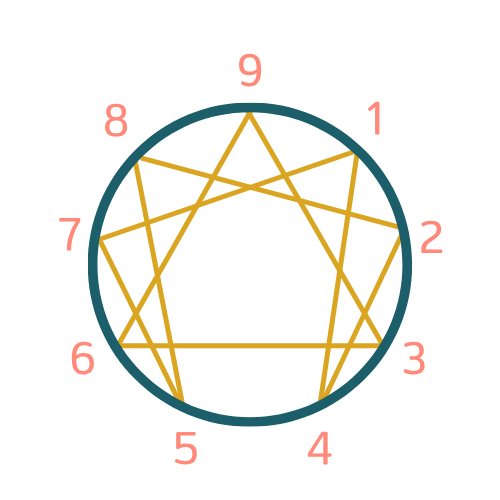
The Enneagram is a personality model that is rooted in both psychology and spirituality. It describes 9 distinct personality types that are outlined on the Enneagram symbol seen above. Each personality type has a core set of patterns in the way they think, feel, behave, and try to solve problems. I see the types less as a set of fixed character traits and more like a pattern of individual strategies attempting to cope with the stress of life and trying to get needs met. Each type looks and feels a certain way when they are healthy and expanded versus when they are fixated and employing more negative ways to get their needs met. Each personality type exists on a spectrum of health from fixated (less healthy) to expanded (more healthy). Most of us exist somewhere in the middle of this spectrum.
Understanding the Spectrum of Health Within an Enneagram Type
As an example of this spectrum, we’ll take a look at Enneagram Type 3. Type 3 is called the Achiever, The Chameleon, or The Performer. They are known to be charming, charismatic, attractive and accomplished according to what their culture values, highly efficient when motivated, and often very hardworking to achieve their goals.
Middle Spectrum Type 3
An Enneagram Type 3 in the middle of the spectrum of health is someone who is seeking love and approval through achievement. Their sense of self-worth is tied to being successful, and they often struggle with embracing authenticity when it conflicts with others’ expectations of them. They also tend to have a relationship with deception—both self-deception and, at times, subtly or playfully deceiving others to maintain a positive image.
Fixated Type 3
When a Type 3 moves toward the more fixated, unhealthy end of the spectrum, these patterns can intensify. This may include more active deception, such as consistent lying or feigning competence. An unhealthy Type 3 may go to great lengths to protect their image and struggle to acknowledge or integrate any sense of failure. At the very far end of this spectrum, this pattern can manifest in more extreme forms, such as narcissism, dark triad tendencies, con artistry, and psychopathy.
Expanded Type 3
At the healthier end of the spectrum, however, Type 3s have a solid and consistent sense of self-worth. They are open-hearted, giving, and maintain a stable sense of self—even when they experience failure or disappoint others. Their worth is felt internally and is no longer contingent on achievement.
From this place, they can experience and give love more freely. There is no need to mask or shape-shift in response to expectations. They are no longer beholden to the idea that their worthiness is negotiable and can choose their heart’s desires freely without fear.
As you can see, this is a very wide spectrum. On one end, narcissism and psychopathy are possible, and on the other end is a person who sees and appreciates the inherent value in everything, including themselves. All 3s will share the same core traits and motivations, but the 3’s relationship with worth, value, and image will determine where they fall on the spectrum. Riso and Hudson, founders of the Enneagram Institute, outlined Levels of Development for each Enneagram type that identifies specific behaviors and internal experiences on the spectrum of health. This can be helpful for clients to determine where they are and where they would like to grow.
Why This Matters in Therapy
Most of us are in the average range of our Enneagram type development, and the goal of the Enneagram is to move more towards health, expansion, love, and groundedness- the healthier end of our type’s expression. Can you see how well this aligns with therapy? I sure do.
Just like any other psychological developmental model, our childhood experiences and life stressors impact our development across our lifetimes. Periods of extreme stress, childhood trauma, and consistent lack of safety can move Enneagram types more towards the fixated end of the spectrum. This is especially true when they don’t have support and access to needed resources or healthy environments growing up. As we get more needs met and develop the capacity to challenge the parts of our Enneagram type that are not serving us, we move more towards health and the expanded traits of our Enneagram type. As a therapist, you are already helping your clients do this even if neither of you knows anything about the Enneagram. But knowing a little about the Enneagram—and how to talk with clients who are already using it—can go a really long way.
How to Begin Using the Enneagram in Therapy
You may be sitting there thinking, “Wow Hanna, this system sounds really complex and requires a lot of study to understand. How can I help my client use this when I know so little about it?” While there are many great training programs available to deeply understand the Enneagram, they take a lot of time, investment, and study. I completed over 150 hours of training before I began to integrate it into therapy. While this level of study is necessary to thoroughly understand the Enneagram, I don’t think as a therapist that you need this level of depth learning to help your clients who want to use it to foster greater self-awareness and help guide their growth as part of therapy.
Identify Enneagram type or possible types
There are many Enneagram tests available to find your type. However, these tests, even the good ones, are frequently inaccurate. I think there are a lot of reasons for this. The Enneagram is as dynamic and complex as the people it represents. Tests don’t account for factors like changes over time, subtypes, body energetics, or how you move between your stress and growth points. Some Enneagram types may even answer test questions in similar ways, despite having very different core motivations. We often respond based on who we aspire to be rather than who we truly are—or, in an inaccurately negative way. Your level of health and growth within your Enneagram type also shapes how you approach and answer these questions.
Additionally, there are different theories and traditions of the Enneagram that significantly impact typing. For these reasons, I always recommend to my clients that they read about all 9 Enneagram types and type themselves based on what resonates with them across the course of their lifetime. I always find myself saying “Don’t let a test tell you who you are.”
Not everyone likes this answer. We often want things to be fast and it feels easier to many of us to take a 20 minute test instead of going through the labor of learning about all 9 Enneagram types. I get this and understand it, but I haven’t found an Enneagram test that is accurate enough of the time for me to trust it. Additionally, the point of the Enneagram is self-insight and self-growth. You engage in an internal self-learning process and typing yourself is a significant and impactful way to start this process.
Your Role as a Therapist
Your role as a therapist is to ask good questions, provide attuned reflections, and help your client dig deeper into understanding themselves so they can identify for themselves what they would like to change. The Enneagram can be a guide in this, but it should always be client centered. Someone may know their Enneagram type, and not yet be ready to dig into the depth work of their type. As we always do as therapists, working with clients where they are is essential. Even though the Enneagram provides a path of growth for each type, your client needs to decide what resonates with them and how they would like to work with it.

Questions to Help Therapy Clients Explore Their Enneagram Type and Integrate It Into Therapy
When a client tells you their Enneagram type, here are some questions you can ask to help them begin to process and dig deeper. Their answers to these questions can also help provide information for the two of you to explore therapeutic directions.
What resonates with you about the Enneagram and using it for self-work?
This question can help your client define what their motivations are and begin to identify how they would like to use the Enneagram as a tool. It will also help determine whether this is a system they really resonate with, or if it’s more of a passive interest or just information they think you need. Just like any other therapeutic tool or theory, if our clients are just passively interested and it doesn’t really resonate on a deeper level, it may not be a good tool for their therapeutic work right now.
How do you see yourself in this Enneagram type? What do you relate to about it?
This question will help your client identify how they see themselves and / or how they think others see them. It will also help them begin to explore their struggles, strengths, and motivations. One of the great things about the way the Enneagram outlines patterns of personality is that clients will often see the patterns that keep them stuck much faster. This can be a great jumping off point for therapeutic work and direction.
What’s it like for you to see yourself described in this way?
People often feel a mixture of vulnerability, relief, and even shame when they see themselves in an Enneagram type. It’s as if someone were holding up a mirror to show you all of the things that are true about you, even the things you try to hide, while reading your journal out loud. It can be jarring, but many also feel a sense of relief that they are not alone and there are other people who suffer in the same ways they do. It can also be a great relief that there is a path forward and they don’t have to stay where they’re at. The Enneagram is about change and growth, that’s the whole point.
How has your Enneagram type helped you?
It is very common for people to feel negatively about their Enneagram type. The negativity bias can be strong here and I’ve seen people interact with their Enneagram type as evidence of ‘what’s wrong with them’. This question can help begin to explore the function of the patterns and make space for self-compassion. I think of our Enneagram type patterns as strategies for coping and trying to get needs met. Just like coping mechanisms, even the negative ones are serving us somehow. It’s the same for Enneagram type.
What was it like for you being this Enneagram type as a child?
Similar to babies being born with temperaments, I personally believe we are born with our Enneagram types. Life, stress, family dynamics, and adapting to cultural and social norms continues to shape how you express your Enneagram type, but it doesn’t necessarily cause it. We stay the same type throughout our lives, but move along the spectrum of health as we grow and interact with the world. Many of the core negative beliefs, internal dialogue, and Enneagram type behaviors begin to form and crystalize in childhood. An Enneagram 8 may recall as a child always having to be strong and protect others, a type 4 may recall painful feelings of being different that persists to this day. This question can also help you and your client begin to explore family of origin dynamics. For example, Enneagram 9’s often report having good childhoods, but when they start exploring the pattern of peacekeeping and minimizing their needs to not bother anyone, they start to come into contact with the pain of not being seen.
What aspects of your type aren’t serving you?
This is a great question to begin exploring therapeutic goals and directions. A type 1 might respond “I know that I have this high need for control and predictability, it causes so much anxiety when I fear I’ll lose control. My brain knows that it’s okay to make mistakes, but I just can’t get the rest of me to believe that.” A type 7 might respond “I need to stop running away. I know I need to be more okay with all of my feelings, but I don’t actually know how to do that. Learning that type 7’s biggest fear is getting trapped in painful feelings and that I’m constantly fighting the fear of missing out really hit me.”
Common Concerns About Using the Enneagram in Therapy
What If You Get Your Enneagram Type Wrong?
This happens ALL OF THE TIME. I myself thought I was 3 different Enneagram types before I found my correct type. I got my type wrong for a few reasons:
I was listening to what other people thought my type was
There were major parts of myself that I didn’t see or understand yet
Enneagram tests mistyped me (they still do)
Most significantly, I hadn’t been exposed to subtype theory yet
The subtype theory describes 27 distinct personality types, not just the core 9. There were major pieces of myself that were not described in the 9 basic personality types but were gut-wrenchingly described in the Enneagram subtypes. So if you feel that you don’t fully resonate with any Enneagram type, I recommend looking into the subtypes.
Do you have to be 100% Sure of Your Type to Begin?
Many people feel that they can’t use the Enneagram unless they are 100% sure about their type, but you absolutely can! This is one of the huge benefits of typing yourself instead of relying on a test. If you resonate with core features of a type, say highly resonating with Type 9’s deep fear of conflict and avoidance of anger, you can start doing the work of type 9 because you identified that this is an issue in your life that causes you problems. Doing the work of the Enneagram type you think you might be can help you gain insights and clarity that aids your growth and that can lead to awareness of your correct type.
Do I Need to Be an Enneagram Expert to Use It in Therapy?
As complex as the Enneagram is, I don’t believe that as a therapist you need extensive training to help your clients use it in therapy. Because as a therapist you already have significant training and experience in human development, recognition of complex recurring patterns, ethics, trauma, and know how to help people grow out of unhealthy patterns, you can integrate the Enneagram into therapy and weave it in with your existing modalities. You need to know a bit about the system and the Enneagram types, but since you are not advice giving in therapy and you are centering your client’s truth about who they are and what they struggle with instead of centering the Enneagram as truth of who they are, it’s just another therapeutic tool for foster self-awareness and growth.
I actually love teaching therapists the Enneagram because they catch on so quickly! When I’m teaching therapists it’s like I can see the cogs turning in their heads as they start thinking of all of their clients, family members, and friends who fit the Enneagram types. They often will start making more connections and come up with new ways to work with the client’s Enneagram type on the spot. It’s pretty fun to participate in nerding out with therapists in this way.
Frequently Asked Questions
Does your Enneagram type change?
This question is super common and the answer is no, we don’t change Enneagram types over time. Many times people will rightfully feel that they are very different as an adult compared to how they were as a child. We certainly grow and change a lot throughout our lives, but in Enneagram terms, we move along the spectrum of health and express different parts of our personalities due to changing circumstances. This can make it appear as though your Enneagram type changes, but the core motivations, driving inner factors, and often the inner voice stay fairly consistent across time. The negative core beliefs that are associated with specific Enneagram types often stay consistent over time until the individual can compassionately challenge their negative beliefs about themselves. As a therapist, this is a major part of how you are already helping Enneagram types when you help your clients identify and change negative core beliefs about themselves. Behaviors, thoughts, and the meaning that we make may change across time, but the core root of the Enneagram type stays and grows with you.
Is the Enneagram evidence based?
Research has offered some good evidence on the validity of the Enneagram and its use as a self-growth tool, and much more research is needed. Some of what we know so far is that the Enneagram has shown correlation with The Big Five and Myers-Briggs. Other research has found Enneagram intensive training to be useful in encouraging psychological growth and healthy ego development. Researchers have found that teaching the Enneagram to psychiatric patients improved self-esteem, interpersonal relationships, and GAF scores. There is more research than what is listed here- and more research is needed to officially call the Enneagram “evidence based”.
Is there a test I can take to identify my Enneagram type personality?
Yes, and I recommend taking the results with a grain of salt. Use tests as a starting point, not a definitive fact. As I described earlier, there are lots of reasons that Enneagram tests may inaccurately type and lead to more confusion. I recommend learning about all 9 types and typing yourself from there. Here is a guide I wrote for typing yourself: https://www.hannawoodycounseling.com/blog/how-to-know-your-enneagram-type-is-right
The Enneagram as a Tool for Growth and Self-Awareness
Next steps in learning how to integrate the Enneagram into therapy include learning more about your client’s Enneagram type and integrating that with what you already know about them. It’s important that you don’t assign an Enneagram trait to a client when they don’t resonate with it. For example, if an Enneagram type 2 knows they’re a 2 but doesn’t yet identify with feeling angry that they do so much for others and no one does the same for them, don’t try to push them towards exploring anger in this way yet, because they are not likely ready for that. It will be more beneficial to focus on the other type 2 areas they resonate with such as feeling guilty saying no to others. In my online and in-person Enneagram trainings for therapists, I go a lot deeper into why this is and help you understand where to start with your clients and gauge where they are at in their Enneagram development. Learn more about Enneagram training for therapists (link to speciality page).
You do not need to become an Enneagram expert overnight to begin having meaningful conversations with your clients about it. If your client is already engaging with the Enneagram and finding value in it, your curiosity, attunement, and ability to ask thoughtful questions already go a long way. Boiled down, the Enneagram is a framework for understanding patterns: the patterns that shape how we protect ourselves, seek connection, avoid pain, and try to get our needs met. Therapy is often about helping clients become more aware of these patterns so they can begin making different choices with greater intention and self-understanding. The Enneagram can support this process by giving language to experiences clients may have struggled to articulate before.
Like any therapeutic tool, the Enneagram is not meant to define people or put them into boxes. It is meant to increase awareness, compassion, and choice. Used thoughtfully, it can help clients better understand the strategies they developed to navigate life, while also helping them change what is no longer serving them. You don’t have to know everything about the Enneagram to begin exploring it alongside your clients. You just have to stay curious, know a thing or two about the types, and ask thoughtful questions that help clients deepen their own understanding.
Ready to learn more?
If you'd like to deepen your understanding of the Enneagram and learn how to meaningfully integrate it into therapy in an intentional, useful way, I offer live Enneagram trainings for therapists. I'm also developing online trainings for therapists who want to learn at their own pace.
Hanna B. Woody is a Licensed Clinical Mental Health Counselor and Enneagram educator in Asheville, North Carolina. She has over 12 years of professional counseling experience and is certified in the Embodiment Tradition of the Enneagram, with over 200 hours of Enneagram training and teaching experience.
Through her private practice and The Therapist's Enneagram, Hanna provides online therapy, Enneagram coaching, and Enneagram training for therapists. Her clinical work specializes in breaking cycles of intergenerational trauma and childhood trauma, helping clients move beyond old patterns and develop a deeper sense of self-understanding, agency, and connection.

I hope this article offers you guidance for beginning to use the Enneagram in therapy and inspires you to lean into curiosity about this powerful therapeutic tool. The Enneagram integrates well with many therapeutic approaches, and as you continue learning, you'll discover how it can help your clients deepen their self-awareness, break longstanding patterns, and support the meaningful work you're already doing as a therapist.